
Gemini 4 Argon: what changes for businesses
Gemini 4 Argon is Google’s new model for complex, multi-step tasks.
It is coming to the app for Pro and Ultra and to business and developer tools.
For a business, its value depends on approved content, rules and verification.

Update · 14 October 2026
The news: where Argon is available
Google introduced Gemini 4 Argon on 30 September 2026 with limited access for cybersecurity partners in the Fairwind Program. Since 13 October, it has been rolling out worldwide in the Gemini app for Google AI Pro and Ultra subscribers; the model is not included in the free plan.
The Google Cloud post, dated 13 October, announces availability in Gemini for business, on the Gemini platform through the API under the identifier gemini-4-argon, in Google AI Studio and in Google Antigravity. Availability in developer tools and free usage are different conditions.
A model for completing complex work
Google describes Argon as a model for “deep work”: detailed tasks in which it needs to maintain context across multiple steps. It can read documents combining text, tables, charts and images and turn them into a structured result.
According to Google, the model respects assigned boundaries, asks for confirmation before irreversible steps and states when it cannot find information or complete a task. These behaviours matter for an assistant working with business documents: they help distinguish an answer, completed work and an action still awaiting approval.
Official Google visual · source
Availability and API pricing
API prices are quoted in dollars per million tokens, the units used to count processed content. They are separate from app subscriptions. The introductory rate ends on 30 November 2026; cached input receives a 95% discount.
| Where it is used | Who can use it | API pricing |
|---|---|---|
| Gemini app | Google AI Pro and Ultra subscribers | API rates are separate from the subscription |
| Gemini for business | Businesses under the service terms | API rates are separate from the service |
| API · AI Studio · Antigravity | Developers and users with access to the relevant tools | Through 30/11/2026: $2 input / $10 output; then $4 / $20 per million tokens |
The results reported by Google
According to Google, use in Antigravity has increased code changes proposed by agents by 35%, with nearly a third fewer rollbacks. ServiceNow reports roughly 20% more completed tasks in its help desk assistant.
Google cites Figma Make for complex prototypes, including 3D games and rich animations; the Gemini notes mention an interactive 3D model. These are results reported by the provider, not tests conducted by Loto: they should not be transferred automatically to another company’s sales.
Design the work before choosing the model
For an Italian company selling products or services, the interesting shift is from assistants that answer to assistants that complete work. One design example: retrieving a product’s features, comparing them with a request and preparing a sales response for approval.
Value comes from authorised content, rules and boundaries: which sources to consult, which operations to perform and when to involve a person. This is the principle behind the AI assistants for businesses we design. A new model helps assess possibilities, but choosing one requires tests on the actual task.
Vucìa · AI assistant for businesses
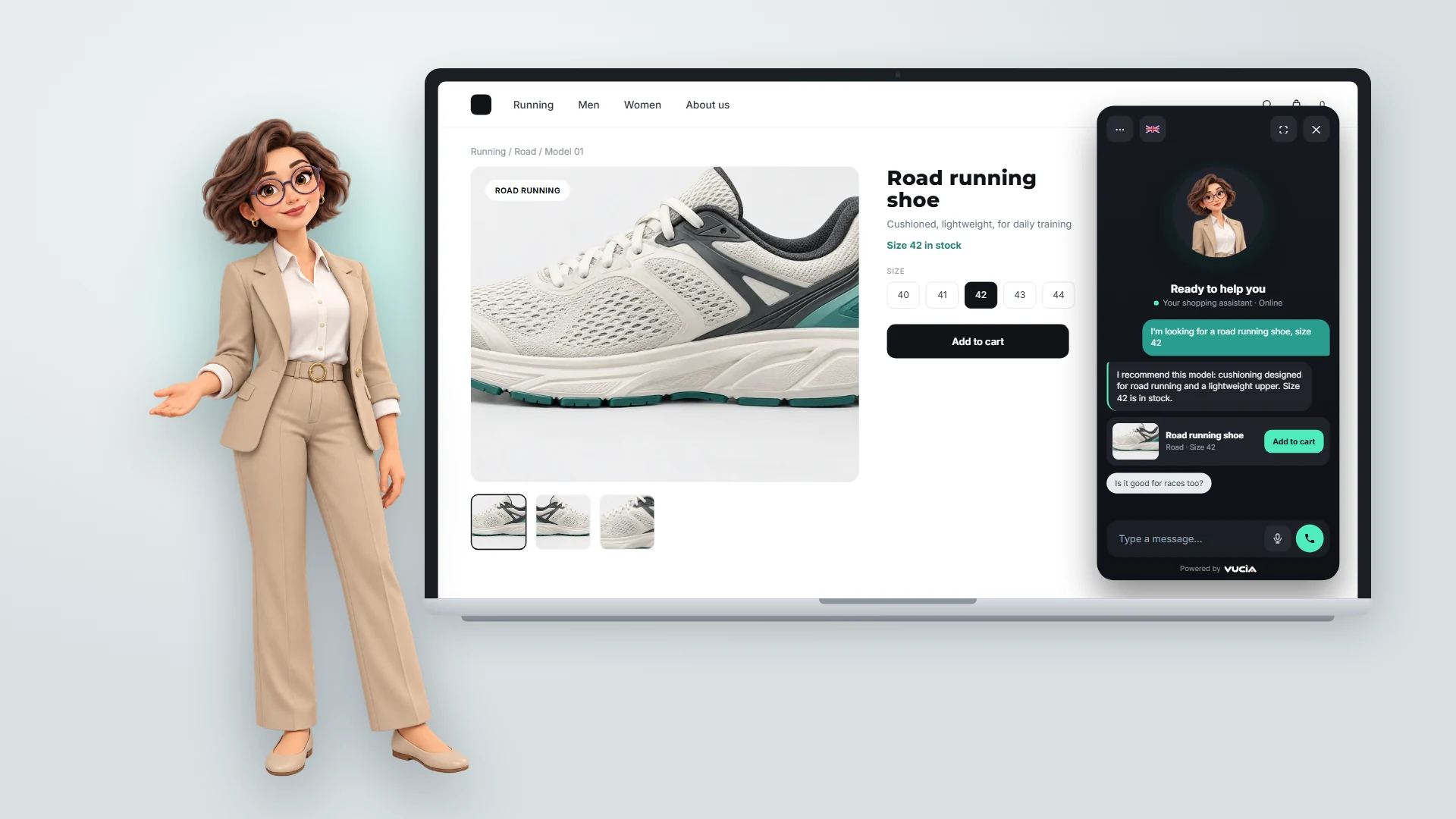

Manuals and catalogues: the knowledge base matters
Documents with tables and images become material that can be consulted in a conversation. For companies selling machinery, furniture or technical services, this can mean finding compatibility information, explaining a feature or locating a procedure without separating the text from its visual references.
However, this requires an organised knowledge base: current versions, consistent codes, recognisable images, units of measurement and responsibility for updates. An outdated catalogue remains outdated even when read by an advanced model. The initial work is to select and approve what the assistant can use and show which document an answer comes from.
Editorial illustration generated for Loto Studios; conceptual image.
Security: the public also brings hostile instructions
An assistant on a website receives text from anyone. Indirect prompt injection tries to introduce hostile instructions into the materials the model reads. According to Google, attack success in the Gray Swan benchmark falls to 0.7% across 15 attempts.
It is a selection criterion, not a universal guarantee. Approved sources, limited permissions and edge-case tests remain necessary in the project. Offensive activities, such as pentesting and exploitation, are blocked in the standard version; access without these limits is reserved for verified defenders. A sales assistant still needs to be designed around its own scope.
3D: from prototype to a product ready to sell
Generating 3D prototypes and animations expands the scope for experimentation: a scene, interaction or journey can be assessed before it is fully developed. To sell, however, assets need to represent the product faithfully: shapes, materials, dimensions and variants must match what the customer can buy.
A product configurator requires compatibility rules and connections to e-commerce and price lists. Interactive applications need to handle real states and actions. In AI content, the prototype should therefore be assessed together with asset fidelity and integration, not just its visual effect.
Loto Studios project · Dallara

Model cost is one part of the project
Token pricing helps estimate processing costs, but the project includes content preparation, integrations, verification and maintenance. The number of sources read and the length of the response also affect consumption. Caching makes sense when reused materials remain accurate and up to date.
With introductory rates through 30 November, it makes sense to consider a pilot focused on one measurable task. Define the expected result first: a source-supported answer, a completed product sheet or a complete draft. Measure accepted work and the human intervention required, then reassess costs at the standard rates.
What to do now: three steps
1. Choose a repetitive task.
Identify a clearly scoped activity and an owner: for example, requests about the features of a product family. Define a usable answer.
2. Prepare and approve the content.
Gather current catalogues, product sheets and instructions. Define which information is public, which actions require confirmation and who handles requests outside the scope.
3. Measure answers and edge cases.
Try ordinary, ambiguous and hostile questions before opening to the public. Check sources, completeness, compliance with limits and cost per accepted result. The decision to extend the pilot should come from these tests.
What we would verify before recommending it for a project
- Sources and references supporting the answers.
- Limited permissions and confirmation before irreversible actions.
- Ordinary, ambiguous and hostile questions; edge cases.
- Cost per accepted result and human interventions.
- Italian-language answers: clarity, completeness and references.
- Current versions, consistent product codes and responsibility for content updates.
Frequently asked questions
Is Gemini 4 Argon available for free?
It is not included in the Gemini app’s free plan. The app rollout is for Google AI Pro and Ultra subscribers; API usage has separate rates.
How much does the Gemini 4 Argon API cost?
Through 30 November 2026: 2 dollars per million input tokens and 10 for output. Afterwards: 4 and 20 dollars. Cached input receives a 95% discount.
Can it read catalogues with tables and images?
Google states that it reads documents with text, tables, charts and images. For a business project, up-to-date content and answer verification remain necessary.
Does 0.7% mean an assistant is secure?
It is the result reported by Google for the Gray Swan benchmark across 15 indirect prompt injection attempts. It does not replace project permissions, rules and tests.
Sources and updates
Gemini release notes, 13 October 2026 · Google Cloud: availability, pricing and reported results.
Updated on 14 October 2026.
Talk to Loto Studios
A concrete task to put to the test
Bring us your process and materials: we assess an assistant or interactive experience with defined content and boundaries.
CONTINUE EXPLORING
Explore business applications
AI assistants for businesses
3D configurator