

THE FOUNDATION
3D configurators to customise products, sell and quote.
A 3D product configurator lets customers, sales teams and dealers change variants, materials, components and optional features while seeing the result in real time.
In more advanced projects, configuration goes beyond the visual: it can connect to compatibility rules, prices, quote requests, e-commerce, CRM, ERP or APIs. What matters is that what users see and what the system records describe the same configuration.
Loto Studios is based in Turin and works with businesses and agencies, including remotely. The studio brings together CAD/STEP pipelines, real-time 3D, UX and software development in a single project. We start with the assets and data actually available, define the required level of configuration and then choose the most suitable delivery technology.
REAL APPLICATIONS
When a 3D configurator is useful — and when a simpler solution is enough.
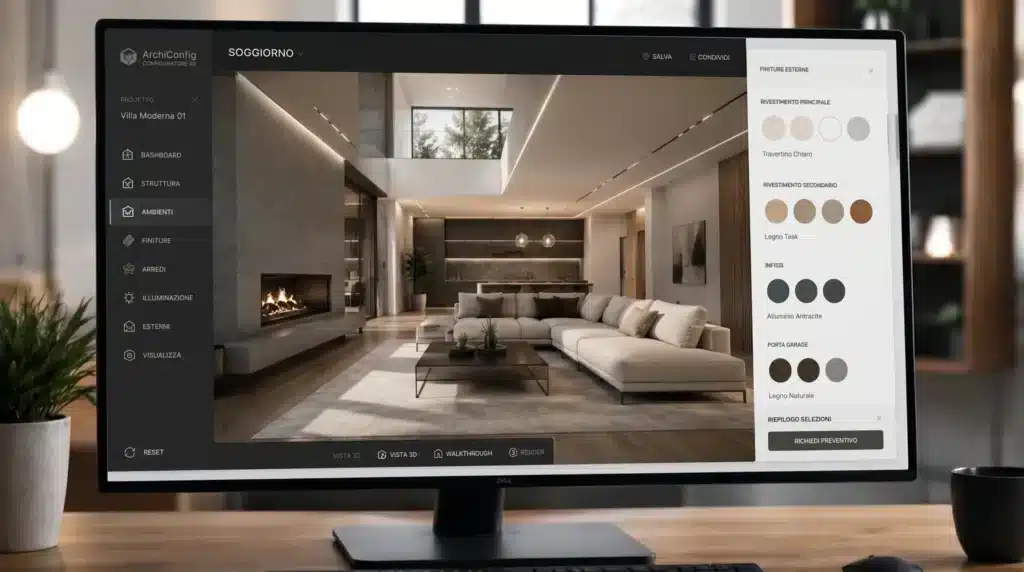
We start with the decisions users need to make. If a choice changes a variant, compatibility, price or sales journey, a 3D configurator can make sense. If the aim is simply to show, explain or explore a product, there are simpler formats to develop and maintain.
It makes sense when the product needs to…
Colours, materials, dimensions, optional features and components generate too many combinations to represent efficiently with separate photographs or renders.
Constraints, dependencies and exclusions must prevent invalid configurations and keep the catalogue, product state and 3D visualisation consistent.
The configuration must continue towards an information request, price, quote, cart or sales network without rebuilding the user’s choices from scratch.
E-commerce, CRM, ERP, PIM or APIs become relevant when catalogue, user and commercial data must stay synchronised with the configuration.
Choose another format when the task is…
WHAT WE DELIVER
From CAD to a valid configuration, beyond the 3D demo.
A reliable configurator combines catalogue, rules, 3D representation, commercial data, integrations and visual quality. We treat these elements as one system.
Input: CAD or STEP files, product families, variants, materials, accessories, compatibility rules, price lists where relevant, target users, languages, channels and systems to integrate.
Output: optimised real-time assets, interface, configuration state, agreed logic, connections to the website/e-commerce/APIs and QA criteria. If prices, customers or orders already have an authoritative system, we define what the configurator needs to read or write rather than duplicating that source.
Before full development, we also establish target devices, behaviour when data is missing, responsibility for updates and acceptance cases: minimum, maximum, incompatible and commercially sensitive configurations.
OUR SERVICES
Types of 3D configurator we build.
The principle is the same, but catalogue, sales channel, fidelity and connected systems change the project significantly. The dedicated pages explore cases where those constraints become specific. To visualise the configuration in its real setting with a smartphone or tablet, discover the augmented reality 3D configurator.
3D Product Configurator
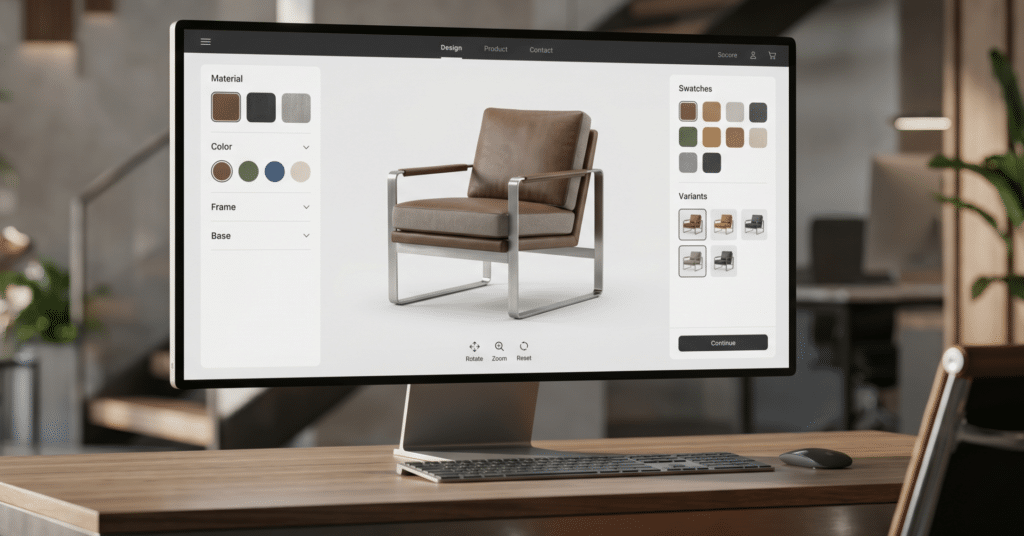
For products with variants in shape, colour, material, finish or accessories. Configuration keeps visual choices and product state consistent.
Web 3D Configurator
Interactive experiences accessible through a browser, integrated into a website or dedicated web app. The priorities are immediate access, performance and continuity with the digital funnel.
Industrial 3D Configurator
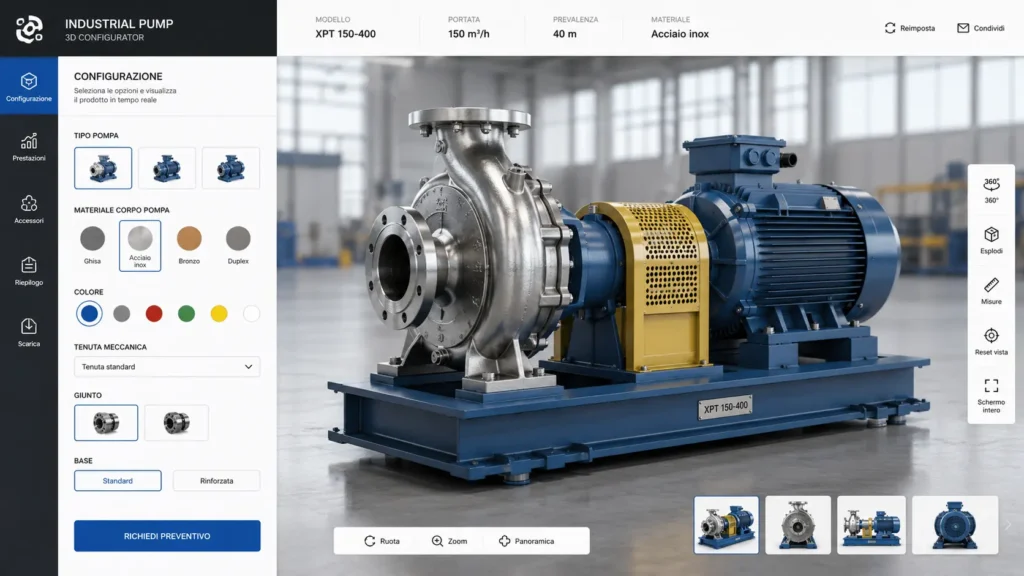
For technical catalogues, machinery and modular components. Rules, compatibility and data can support sales teams and quotations.
Augmented Reality 3D Configurator
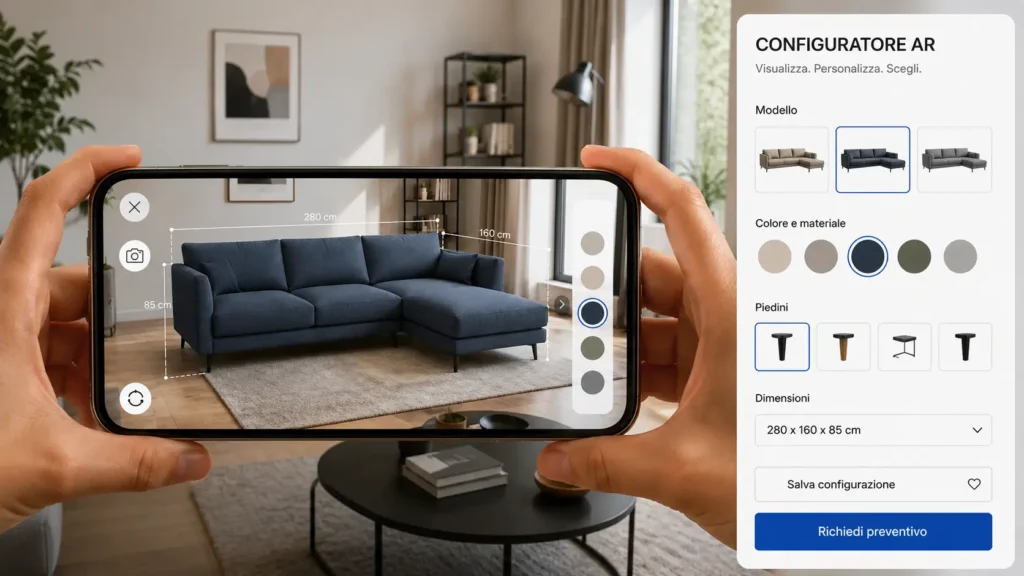
To visualise product variants and materials in their real setting using a smartphone or tablet. Useful when scale, dimensions and context influence the choice.

Automotive 3D Configurator
For vehicles, specifications, materials, interiors and optional features with high real-time quality. The platform is selected according to visual fidelity, distribution and devices.
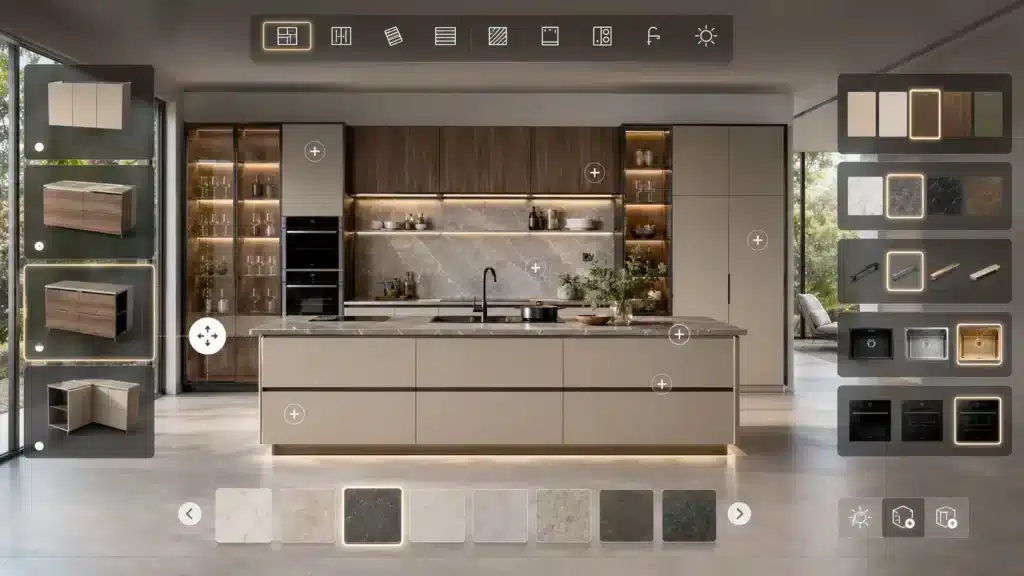
E-commerce 3D Configurator
Configuration connected to a catalogue, variants and the online purchasing journey. Where the architecture supports it, the selected state can continue towards a price, cart, lead or account.
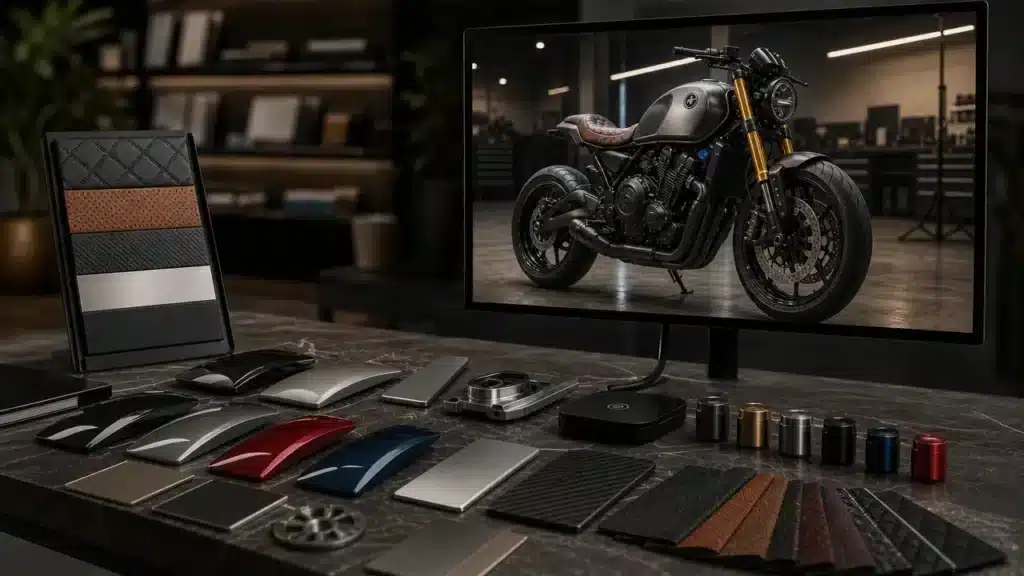
Showroom Material Configurator
An experience designed for physical showrooms, material samples and assisted presentations. Useful when the exhibition space cannot show every catalogue combination.
CONFIGURATOR IN ACTION
A real example of 3D configuration.
The video presents a product configurator with 3D visualisation and real-time selection of colours, materials and components.
OUR PROCESS
From the product catalogue to a live configurator.
Four stages with one simple rule: validate the catalogue and complete journey early, rather than modelling everything before knowing whether data, rules and integrations work together.

Catalogue and rules
We collect assets, variants, constraints and commercial data, and define what users need to be able to choose.
01

UX and prototype
We design flows, the interface and initial interactions to validate the journey before full development.
02

3D and development
We optimise real-time assets and implement the planned rules, variants and integrations.
03

QA and release
We check configurations, compatibility, performance and connections before publication.
04
TECHNOLOGY AND CONTROL
Six layers must stay consistent. Then we choose how to deliver them.
Catalogue, rules, 3D, commercial data, integrations and visual quality form a single system. A configurator does not become more reliable simply because its rendering looks better or it contains more options.
01 · CATALOGUE + RULES
The product must be valid
Families, options, dependencies, exclusions and limits define what can be selected. The 3D must read the same state rather than reconstructing it separately.
02 · 3D + ART DIRECTION
The product must be credible
Geometry, materials and components respond to selections while maintaining performance and visual consistency. The real-time pipeline is calibrated to the channel and brand positioning.
03 · BUSINESS + SYSTEMS
The configuration must continue
Where needed, the selected state continues towards a price, quote, lead, cart, CRM, ERP or API. Each connection is defined with a data source and a precise output.
WebGL, Pixel Streaming or a dedicated application?
Delivery technology follows from the use case: audience, required quality, scene complexity, devices, network, operating costs and the need to work offline.
WEBGL / WEB 3D
Immediate browser access
Suitable when the configurator needs to be easy to access and integrate into the website. Assets and shaders must respect the performance budget of users’ actual devices.
PIXEL STREAMING
Real-time quality from the cloud
Useful when a scene requires a level of quality or complexity that is difficult to deliver to the browser. GPU infrastructure, network, latency and concurrent users then become part of the scope.
APP / KIOSK
Controlled hardware or offline use
Suitable for showrooms, trade shows, dedicated stations or peripheral integrations. Installation, updates and hardware compatibility become part of the deliverable.
QUOTATION
Have a product to configure, but unsure how much of a system it needs?
Send us the catalogue, CAD or STEP files, variants and commercial goal. We tell you whether you need a viewer, a visual configurator, a rules-based system or an integration closer to CPQ before sizing development and infrastructure.
PRICES AND TIMING
How much a 3D configurator costs
Indicative starting prices.
| Configurator type | Indicative price | Indicative delivery | Action |
|---|---|---|---|
| Web / product | From €2,000 | 10–20 working days | Request a quote |
| Industrial | From €3,000 | 30–40 working days | Request a quote |
| Augmented reality | From €4,000 | 20–30 working days | Request a quote |
| Automotive | From €6,000 | 30–40 working days | Request a quote |
| Advanced 3D e-commerce | From €8,000 | 40–50 working days | Request a quote |
Projects with extensive catalogues, CPQ, backend or numerous integrations need a dedicated assessment. Before quoting, we separate 3D preparation from product logic, UX, development and integrations, making it clear what is driving the scope.
WHICH SOLUTION IS RIGHT?
Viewer, configurator or CPQ? And when is it a digital twin?
The label matters less than the flow: which choices are allowed, which state is saved and which system needs to receive the result.

SHOW / EXPLORE
Rendering or 3D viewer
Rendering when the result is fixed; a viewer when users need to rotate or inspect a model without a product rules engine.
CUSTOMISE
3D Configurator
When users need to change materials, variants, components or optional features and see the result in real time.
SELL / QUOTE
Integrated Configurator / CPQ
When a choice needs to generate a price, lead, quote, bill of materials or data to send to business systems.
Digital twin is not a synonym for configurator. A configurator defines a possible or selected product variant; in a digital twin, the model is linked to the identity or state of a real asset and can receive operational data, telemetry or updates from the physical world. If the requirement is to monitor what is happening to a real machine, the project changes category.
CASE STUDIES
3D configurators we have developed.
Industry, automotive and web show how the same principle can become very different commercial tools.

EUROFORK · INDUSTRY
LogiMAT 2026
An interactive 3D catalogue designed for commercial presentations at LogiMAT and web use: a real example of reusing the same 3D content across an event and a digital channel.
DALLARA · AUTOMOTIVE
Automotive Configurator
Real-time configuration of the Dallara Stradale delivered on the web through Pixel Streaming: a case where visual quality and distribution form part of the same technical decision.
FORME DESIGN · WEB
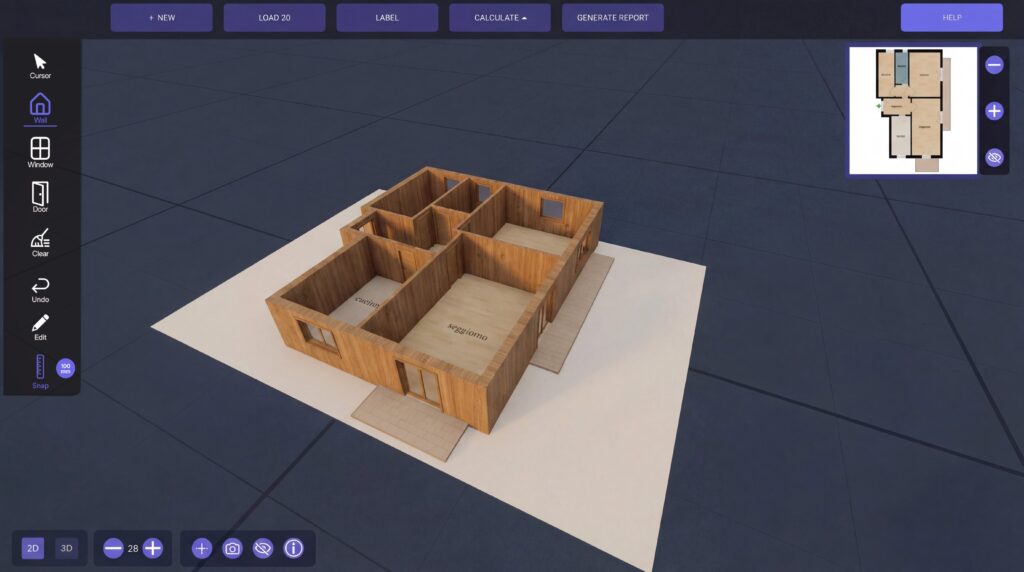
PlanEstimator
A 2D/3D platform connecting a floor plan, surface calculations and the quotation process: 3D becomes a step in a commercial workflow rather than an isolated element.
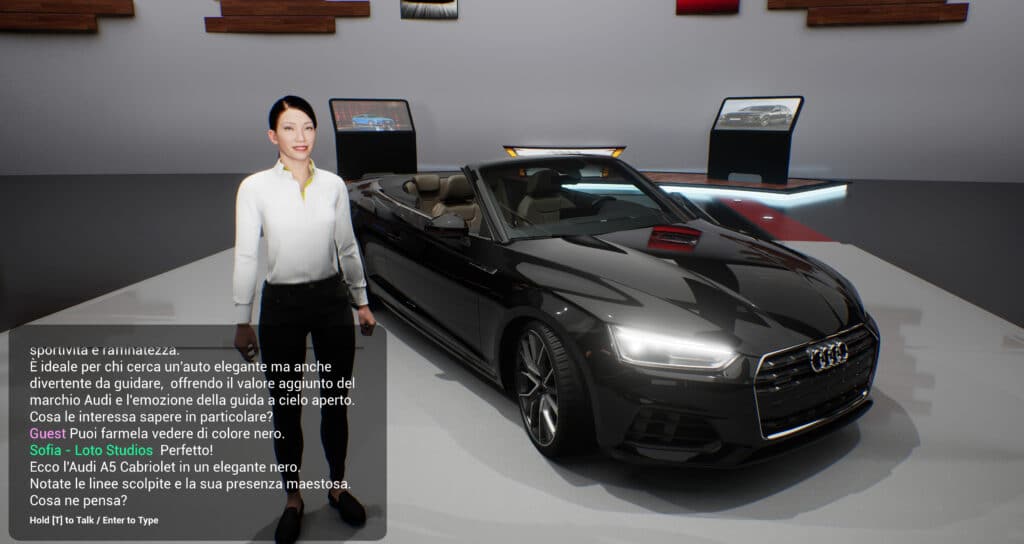
AUDI A5 · AI AGENT
AI Configurator
Real-time configuration supported by a conversational AI assistant: the case shows how the visual interface can be accompanied by guidance through choices while keeping configurator and chatbot roles distinct.
FREQUENTLY ASKED QUESTIONS
FAQ about 3D configurators.
What is a 3D product configurator?
An interactive application that lets users modify a product by selecting variants, materials, colours, components or optional features and see the result in real time.
Can we start with our CAD or STEP files?
Yes. We first check whether the geometry is suitable for real-time use and optimise assets where necessary.
Can it integrate into our website or e-commerce?
Yes. We can connect the configurator to a catalogue, cart, lead form and backend through APIs where the architecture supports it.
How much does a 3D configurator cost?
Indicative starting prices are €2,000 for web configurators, €3,000 for industrial configurators, €4,000 for AR experiences, €6,000 for automotive configurators and €8,000 for advanced e-commerce solutions.
How long does it take?
A simple web configurator typically takes around 10–20 working days; industrial or automotive projects normally require 30–40 days, while advanced e-commerce integrations may require 40–50 days.
What is the difference between a 3D configurator and CPQ?
A configurator defines and represents a valid product variant. CPQ adds commercial configure-price-quote logic: prices, terms, approvals and quotations. The two systems can be integrated without being part of the same software.
Is WebGL, Pixel Streaming or a dedicated application better?
It depends on the balance between accessibility, visual quality, scene complexity, devices, network and operating costs. WebGL reduces access friction, Pixel Streaming moves rendering to cloud GPUs, and an app is useful when hardware, offline use or peripherals need to be controlled.
Is a 3D configurator a digital twin?
Not necessarily. A configurator describes a possible or selected product variant; a digital twin is linked to an identified real asset and its operational state. Telemetry, sensors or synchronisation with the physical object change the project’s scope.
What can we update after go-live?
It depends on the agreed architecture. Catalogue, copy, materials, rules, prices or translations can be managed through different sources: we define which data stays in the client’s systems, which can be edited through a backend and which needs a new 3D asset release.
What information is needed for an initial estimate?
The product or families to cover, available CAD or STEP files, the number and types of variants, compatibility rules, any price lists, target users, distribution channel, systems to integrate and an indicative deadline. These details help distinguish visual complexity from software complexity quickly.
Eurofork: from LogiMAT to the web
Need: make complex intralogistics products explorable at a trade show. Starting material: industrial products modelled and optimised in 3D, with a dedicated interface for the catalogue and its variants. Result: an interactive 3D catalogue developed for Eurofork on commission from Point Architects. Use: touch kiosks and dedicated stations at LogiMAT, plus a web version that extends access beyond the stand.
Explore the Eurofork project →Tell us which products and variants users need to explore, and whether the experience is for a stand, the web or both. Network requirements and offline use depend on the chosen solution.
LET’S TALK ABOUT YOUR PROJECT
Let’s assess your configurator, starting with the product rather than the technology.
For an initial discussion, you do not need to have chosen WebGL, Unreal, a backend or CPQ. We do need enough information to understand what users must be able to choose and what needs to happen afterwards.
AN INITIAL DISCUSSION
Products, variants and systems to connect.
Share the catalogue, available 3D files and configuration rules. We can then assess the experience and required integrations together.
REQUEST AN INITIAL DISCUSSION
Tell us about the product to configure.
The fields below are optional and help us tailor our first response.