

CORPORATE TRAINING IN VR
Immersive training for procedures, safety and operational scenarios.
Corporate VR training lets people practise procedures and decisions within an interactive 3D scenario. Loto Studios develops custom applications: environments, tools, assistance levels and assessment are designed around the tasks to learn, rather than a catalogue of standard courses.
In the real VR Training project we developed 3 modes: learning, practice and advanced, with 3 session measures: times, errors and scores. These are documented project features, to be defined for each new application. For other scenarios, explore our Virtual Reality service.
When learning by doing is needed
Technical procedures, maintenance, safety, tool selection, operational sequences and scenarios that are difficult to reproduce physically.
When transferring linear knowledge is enough
If the content is mainly theoretical and does not require presence, space or action, video, e-learning or traditional training may be more efficient.

WHAT THE TRAINING CAN INCLUDE
From scenario to training session.
Functions depend on the process to be simulated. We do not sell a generic “VR package”: we define what users need to see, do and verify.
Operational procedures
Guided or independent sequences to practise steps, action order and correct tool use.
Safety and emergencies
Scenarios in which errors, access or real conditions would make a physical trial expensive, complex or risky.
Technical training
Interaction with virtualised machines, components and environments when the skill requires spatial understanding.
Progressive modes
The real VR Training project implemented teaching, practice and advanced modes with different levels of support.
Quizzes and feedback
When included in the project, quizzes, guidance and checks can be integrated directly into the scenario.
Session data
The VR Training case study collects times, errors and scores to analyse session performance.
REAL DEMO
Training built around concrete technical operations.
The project documented in our portfolio shows a VR environment for technical and maintenance activities, with tools, procedures, progressive modes and session assessment. The video demonstrates the work; it is not a stock demo.
VIEW THE CASE STUDY →PROCESS
The procedure first, then the headset.
Training quality depends on process fidelity and a clear objective, rather than the number of immersive effects.
Objective
We define skills, users and the expected session outcome.
Procedure gathering
We study steps, tools, materials and constraints of the real context.
Scenario and interactions
We design the environment, objects, feedback and required level of guidance.
Device testing
We check usability, readability, comfort and correct flow.
Delivery and iteration
We prepare the experience for its intended use and plan possible developments.
PRICE INDICATION
Quoted for your project
YOUR QUOTE
Scope, complexity, supplied assets, outputs and revisions are reviewed before confirming the quote.
REAL PROJECT
VR Training: from real maintenance to immersive simulation.
The VR Training project documents three modes: teaching with dynamic quizzes, practice with infographics and advanced training without assistance. The tool records three session metrics: times, errors and scores. These are implemented features, not effectiveness percentages: the public case study does not report measured savings or learning improvements.

TOOLS AND PREPARATION
Interactions consistent with the procedure
Users select the equipment and devices needed before entering the operational scenario.
EXPLORE THE PROJECT →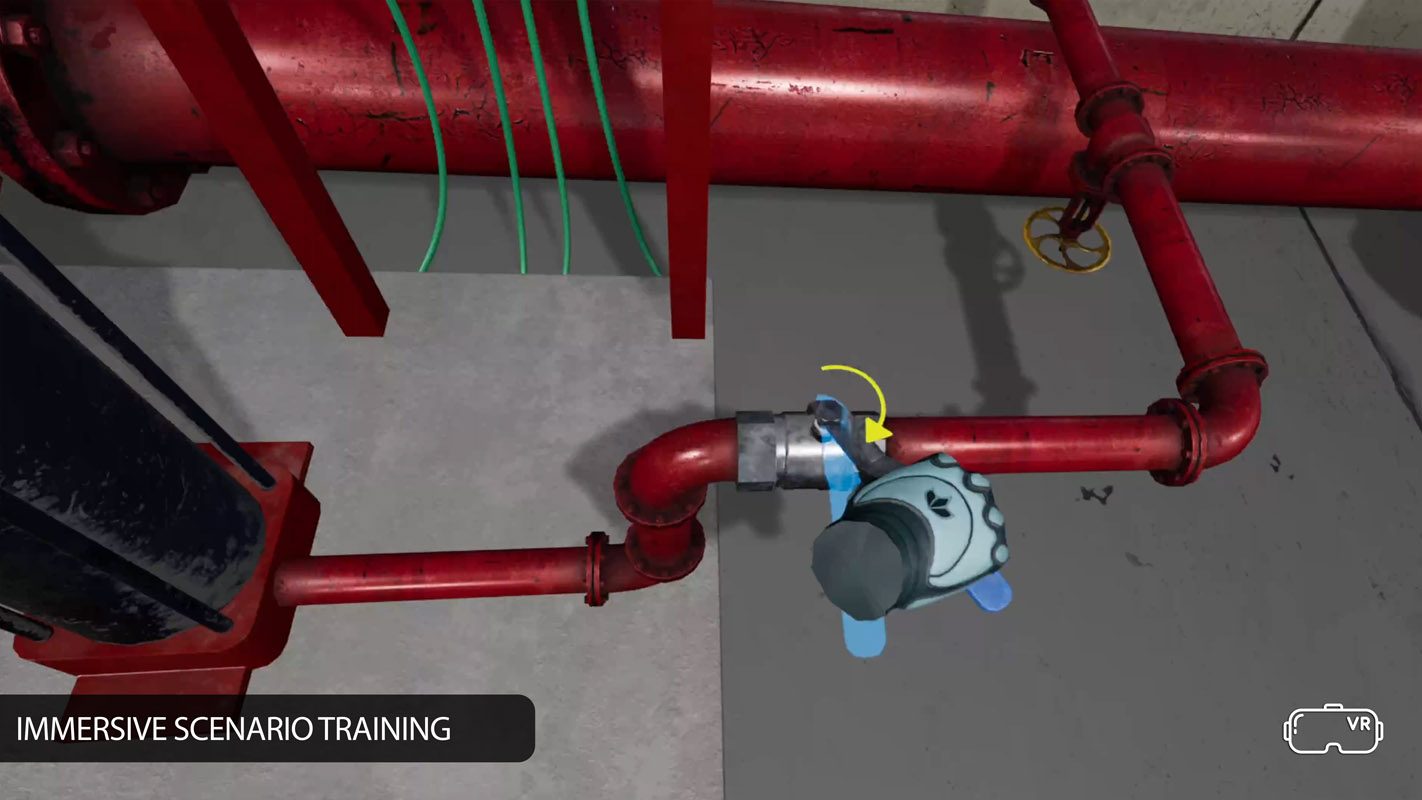
OPERATIONAL SCENARIO
Actions within a controlled environment
The training allows users to tackle technical steps and maintenance sequences without exposing them to the real risk.
VIEW THE CASE STUDY →
ASSESSMENT
Support, practice and evaluation
The project integrates quizzes and modes with different assistance levels, up to the advanced test without help.
LEARN MORE →COSTS AND PLANNING
How much does corporate VR training cost, and how long does development take?
The project and quote are defined after reviewing the procedure, materials and intended use. The number of scenarios, interactions, devices and integrations determines the investment; the schedule and activities are agreed after the brief.
What determines the investment
The number and complexity of scenarios, 3D reconstruction, interactions, training modes, testing and deployment affect the work. Reusable assets can reduce reconstruction tasks; compatibility and quality must be checked.
From brief to headset testing
The schedule includes gathering the procedure, storyboarding, an interactive prototype, review with the training lead and testing on the device. Missing assets, changes to the procedure and integrations can affect planning. Dates are agreed for a defined scope, not guaranteed before the brief.
What to clarify in the quote
Specify users, available headsets, scenarios and assessment criteria. Hardware, licences, integrations, onboarding and support must be listed explicitly: they are not all automatically included in simulation development.
ITALIAN REGULATORY CONTEXT
VR training and safety: the Italian State–Regions Agreement
For projects subject to Italian workplace safety training rules, the reference is the State–Regions Agreement of 17 April 2025, no. 59/CSR. Part IV, section 2.4 includes VR and AR among active teaching methods; it specifies that they do not replace the practical component of the courses identified in points 7 and 8.
A VR application does not automatically make a course compliant or independently confer a qualification. For mandatory training, the training provider must check course requirements, permitted delivery methods, assessments and required practical activities. Loto Studios develops the tool and scenario; their role within the training programme must be defined before production. This section concerns Italian rules, not a statement of compliance in other countries.
Read the official Italian agreement · part IV, document pp. 94–95
FAQ
Questions about corporate training in VR.
Useful decisions before turning a procedure into an immersive experience.
How much does a VR training project cost?+
The cost depends on the number of scenarios, 3D assets, interactions, devices and integrations. The quote is defined after the brief; hardware and additional services must be specified separately.
How long does it take to develop VR training?+
It depends on scenarios, materials, interactions and testing. The schedule is agreed after the brief and includes a prototype and review with the training lead. We do not state a standard duration before understanding the procedure and devices.
Which headsets are needed for VR training?+
An immersive experience requires a VR headset. We assess standalone or computer-connected devices according to graphics, mobility, interactions and station management. The compatible model and requirements are defined in the project and tested on the selected device.
How is learning assessed in VR training?+
In the VR Training case study, times, errors and scores are recorded. The assessment model is defined according to the scenario.
Does VR replace mandatory workplace safety training?+
Not automatically. Under Italy’s State–Regions Agreement of 17 April 2025, VR and AR are active teaching methods but cannot replace the practical component of the courses in points 7 and 8. The training provider must check the requirements applicable to the programme.
LET’S TALK ABOUT YOUR PROJECT
Do you have a procedure that is difficult to train today?
Describe who needs to learn, which actions they need to perform and in what context. We assess whether VR is the right choice and which materials are needed to build the training.
AN INITIAL DISCUSSION
Scenario, users and devices.
We start with the activity to simulate, the available materials and the intended headsets. Together, we define content, interactions and validation steps.
REQUEST AN INITIAL DISCUSSION
Tell us about the experience to develop.
The fields below are optional and help us tailor our first response.