

AR for tourism and culture
Read a place through what is no longer visible.
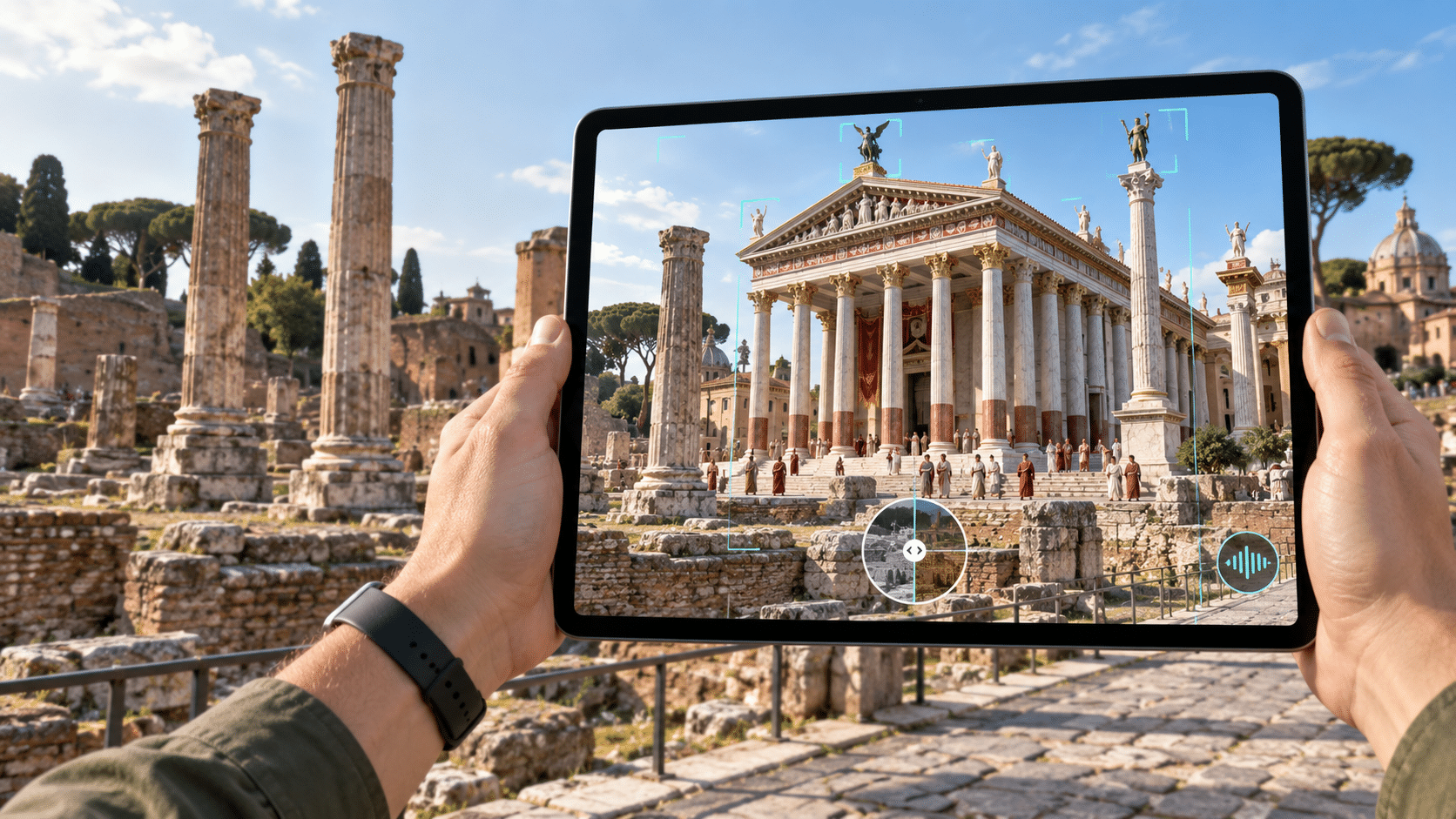
Augmented reality for tourism and culture overlays reconstructions, digital artefacts and information on a real place or object. We design experiences for museums, sites and visitor routes while keeping digital content connected to its physical context.
We start with an interpretation goal: showing a transformation, explaining a function or comparing an artefact with its reconstruction. Sources, text and reconstructions are reviewed with the scientific leads. An evocative image is not historical evidence: documented information, hypotheses and illustrative elements are kept distinct.
When it helps
Comparison with the actual place
When seeing existing features and reconstructed content in the same location makes a visit easier to understand.
When to choose differently
A visit without the camera
If audio, text or a navigable panorama is enough, an audio guide or virtual tour may be simpler and more accessible.
OUTPUTS AND INPUTS
What the project can include.
01
Contextual reconstructions
We prepare models and content at a scale and from viewpoints suited to the visit. Hypothetical elements require an explicit editorial decision.
02
Artefacts and interpretation
3D objects, labels, animation and narrative can explain hard-to-see details. Content quantities and languages follow the agreed route.
03
Visitor experience
We define access, instructions, fallback and usage points. Visitor-owned phones and venue-provided tablets bring different management and support requirements.
What we need to begin
Visitor objectives, sources and scientific review, surveys or photographs, available models, viewpoints, languages, devices and site constraints.
TECHNOLOGY AND LIMITS
Test the digital experience in the actual place.
Low-light interiors, glass, crowds, sunlight and weak connectivity can affect behaviour. We choose markers, recognition and positioning after an on-site or representative test. Accessibility, readability and an alternative without the camera are part of the design; we do not assume every visitor can or wants to use AR. Rights to heritage, imagery and content must be clarified before production.
PROCESS
From a representative test to delivery.
01
Route and sources
Define what to explain, which sources to use and who approves content.
02
Context test
Test one visitor point and recognition method on the intended device.
03
Production and review
Prepare models, text and narrative while distinguishing reconstruction from hypothesis.
04
Visitor-route test
Check instructions, duration, readability and fallback; deliver the agreed route.
FAQ
Practical questions before starting.
Is this a virtual tour?
Not necessarily. A virtual tour lets people explore a digital space, including remotely. AR relates content to the place or object the visitor is observing.
Who validates the reconstructions?
The scientific or editorial leads nominated by the client. Loto prepares the representation and makes choices explicit; it does not replace the authority of historical sources.
Can visitors use their own phones?
This can be assessed against the intended devices, browsers and connectivity. Alternatively, venue-managed devices can be considered with dedicated support and management.
Can it be used outdoors?
Yes, where conditions and tracking permit it after testing. Direct sunlight, weather, surfaces and connectivity must be included in the brief; we do not promise universal operation.

LET’S TALK ABOUT YOUR PROJECT
Which place or artefact would you like visitors to understand?
Share the route, available sources, audience, languages and visiting conditions. We define the first point to prototype and the leads responsible for review.
AN INITIAL DISCUSSION
Context, content and devices.
Share the route, available sources, audience, languages and visiting conditions. We define the first point to prototype and the leads responsible for review.
REQUEST AN INITIAL DISCUSSION
Tell us about the experience to develop.
The fields below are optional and help us tailor our first response.