HEALTHCARE VIRTUAL REALITY
Healthcare training and simulation in immersive environments.
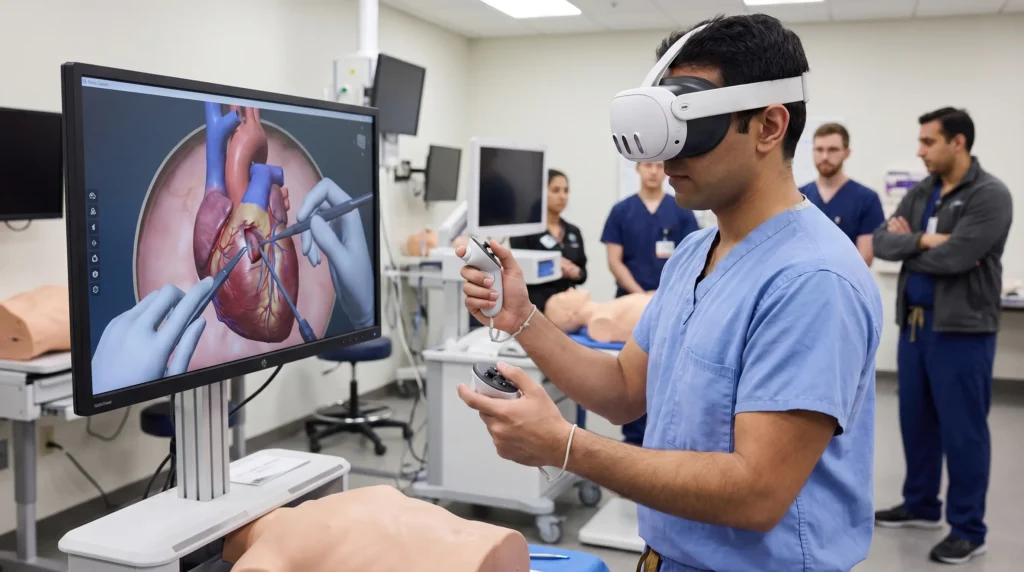
Healthcare VR transforms procedures, environments and training scenarios into interactive 3D experiences when learning requires space, sequence, decisions and repeatable practice.
We design applications for training, simulation and experiential learning, starting from protocols, technical materials and real learning objectives. This page is a specialisation of our Virtual Reality service and does not, by default, replace medical devices, diagnostic systems or regulated treatment pathways.
When practice within a scenario is needed
Procedures, spatial orientation, tool use, operational sequences, teamwork and situations that need to be repeated without involving a real patient.
When explaining or showing is enough
If the main objective is to visualise anatomy, a device or a process without immersive interaction, medical 3D animation or video may be more suitable.
USE CASES
What a healthcare VR simulation can include.
Technology is chosen after defining what users need to learn, do and verify. There is no single medical VR training format suitable for every scenario.
Procedures and protocols
Guided or independent sequences to practise steps, action order and familiarity with the operational context.
Environments and onboarding
Explore departments, spaces, workflows and workstations when understanding the environment is part of training.
Devices and tools
Interaction with virtual models of tools or equipment when suitable technical data and references are available.
Critical scenarios
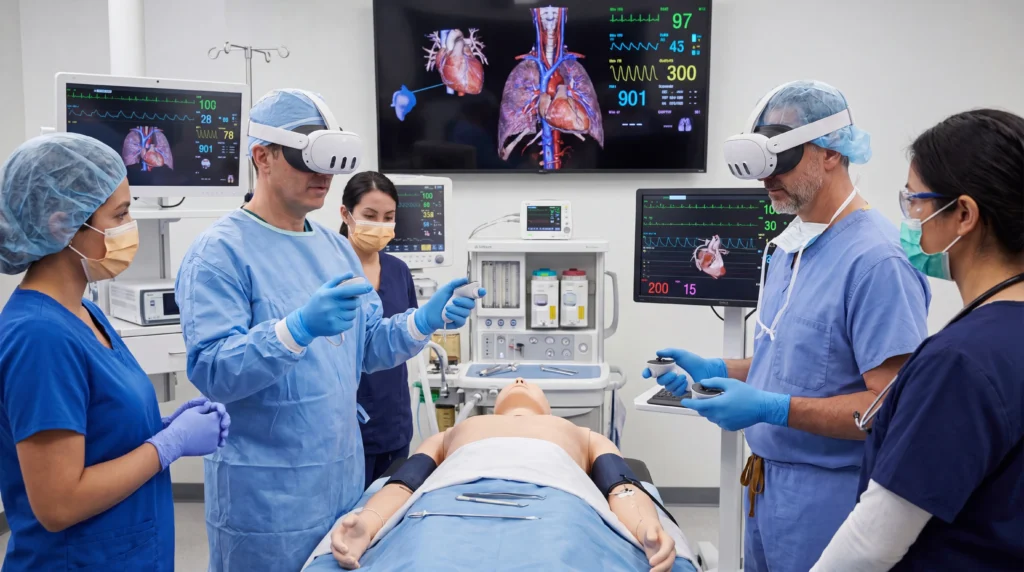
Controlled, repeatable simulations to practise decisions, coordination and sequences without using a real patient.
Feedback and assessment
Times, errors, completed steps and quizzes can be tracked when explicitly required by the training project.
Data and biofeedback
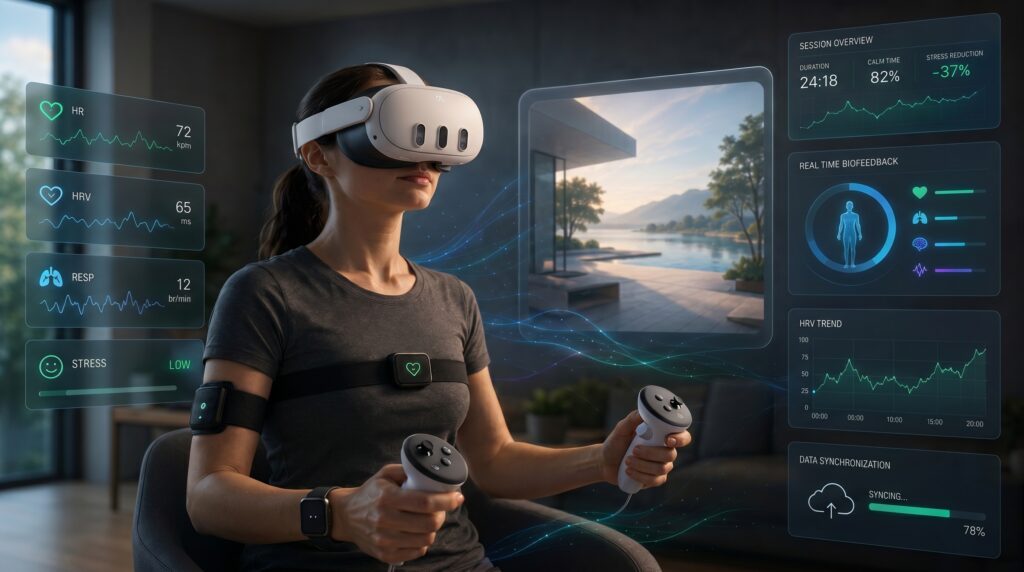
When required by the use case, the experience can integrate telemetry and sensors, as demonstrated by BECOME.
REAL PROJECT · BECOME
VR, biosensors and environments that respond to physiological data.
For BECOME, Loto Studios developed an XR platform in Unreal Engine integrating immersive environments, biosensors and real-time analytics. It provides concrete evidence of VR and data integration, rather than a general promise of clinical effectiveness.
VIEW BECOME →PROCESS
From healthcare procedure to VR simulation.
Work starts with real content and constraints. Useful fidelity is what the learning objective requires, rather than detail for its own sake.
Objective
We define users, skills and the expected session outcome.
Sources
We collect protocols, manuals, images, videos, CAD and available references.
Scenario
We design the environment, interactions, feedback and level of assistance.
Build and testing
We check workflow, readability, comfort, performance and interaction consistency.
Validation and delivery
The solution is reviewed with the relevant stakeholders and prepared for the intended hardware and context of use.
PRICE INDICATION
Starting from €4,000
YOUR QUOTE
Scope, complexity, available materials, outputs and revisions are reviewed before confirming the quote.
REAL PROJECTS AND CAPABILITIES
Two projects demonstrate technical components relevant to healthcare VR.
BECOME demonstrates data and biofeedback integration; VR Training demonstrates procedures, progressive levels, tools and session assessment. These are related technical examples and do not automatically constitute clinical validation.
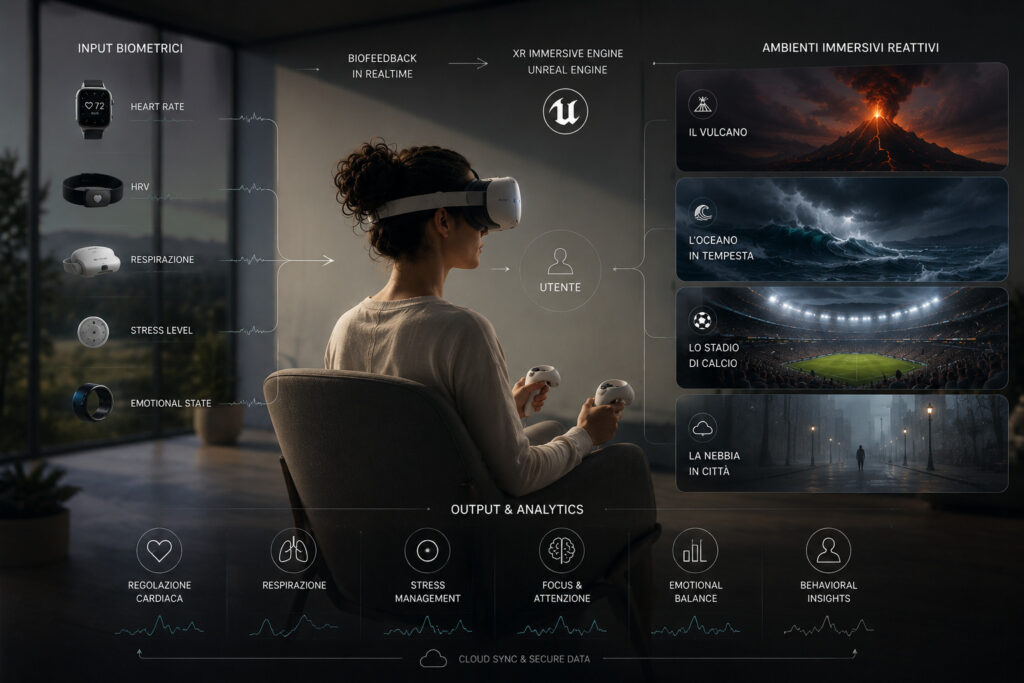
BECOME · XR + BIOFEEDBACK
Sensor integration and real-time analytics
Reactive XR environments developed in Unreal Engine, connected to physiological data and monitoring systems.
VIEW THE PROJECT →
VR TRAINING · PROCEDURES
Progressive training with session assessment
A real project with educational, practical and advanced modes, interactive tools and collection of times, errors and scores.
VIEW THE CASE STUDY →FAQ
Questions about virtual reality for healthcare.
When is VR useful in healthcare training?+
When learning and assessment depend on environment, sequence, interaction, decisions or coordination. If showing content is sufficient, a video or 3D animation can be more efficient.
Is a healthcare VR simulation automatically a medical device?+
No. The scope depends on intended use and project requirements. Our training applications must not be presented as diagnostic or therapeutic tools without a specific requirements, validation and compliance process.
Can we start from existing protocols, CAD or materials?+
Yes. Manuals, procedures, images, videos, CAD and 3D models are reviewed to identify what can be reused and what needs rebuilding or simplifying for real-time use.
Can session data be collected?+
Yes, when required. Times, errors, completed steps, scores or telemetry can be designed into the system; any personal or health data require a specific analysis of processing and architecture.
Standalone or PCVR?+
Standalone simplifies distribution and cabling; PCVR offers more graphics power and hardware integration options. The choice follows the scenario.
How much does a healthcare VR project cost?+
Starting from €4,000. The quote depends on scope, complexity, available materials, outputs and revisions, and is confirmed after reviewing the brief.
LET US ASSESS YOUR USE CASE
Do you have a healthcare procedure or scenario to turn into a simulation?
Describe users, objectives, available materials and context of use. We assess whether VR is the right medium and which technical or validation requirements need considering.
REQUEST AN INITIAL DISCUSSION
Tell us about your scenario.
Three initial details help us understand the scope; the form is the standard Loto Studios form.