Virtual reality for schools and universities: learning through experience
Virtual reality for education enables schools and universities to offer simulated laboratories, explore complex phenomena and build educational guidance experiences. Students can observe, experiment and repeat activities in interactive environments designed together with teachers.
Universities, technical schools and vocational training centres can use these experiences to connect theory with practice, develop skills and help students choose their course of study.
Through interactive virtual environments, it is possible to simulate procedures, visualise phenomena that are difficult to explain with traditional tools and enable users to learn through direct experience.
Why virtual reality works in education: more engagement, better memory
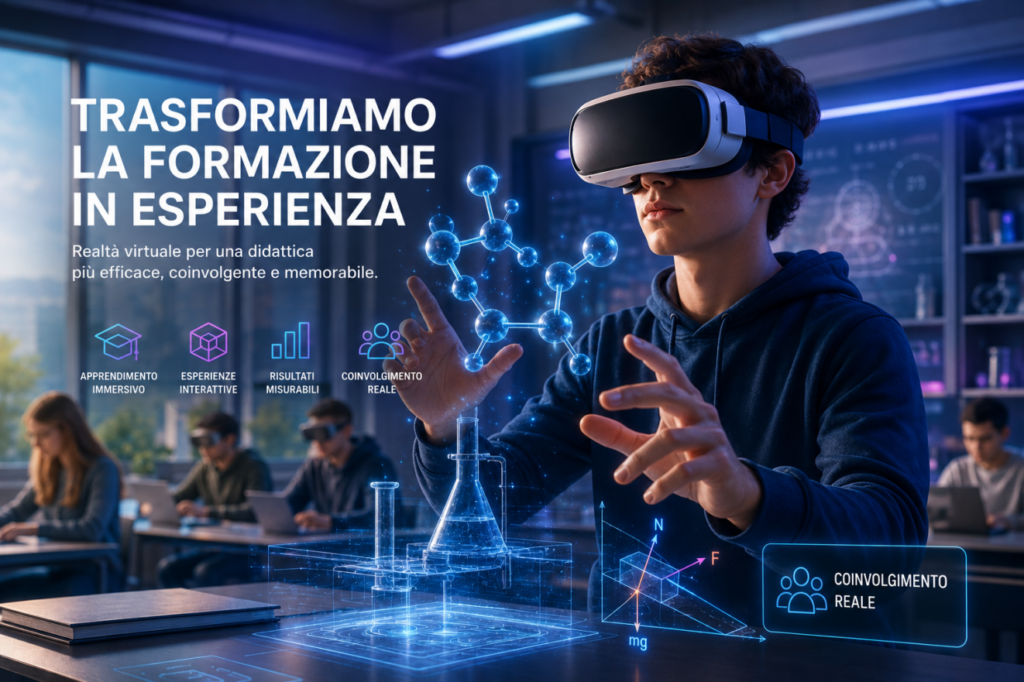
When a student reads a formula in a book, they activate just one cognitive mode: reading. When they see the same phenomenon explained in a video, they activate two: reading and listening. When they enter a virtual reality environment and directly manipulate the variables of a system, they activate hearing, sight, proprioception and spatial memory together.
It is the difference between studying the combination of forces on an inclined plane and seeing force vectors appear around an object moving before your eyes.
Several international studies on retention rates show that experiences lived in VR are remembered more easily and applied more naturally, reducing the gap between theory and practice. The explanation is simple. The brain does not clearly distinguish between lived experience and realistically simulated experience, and stores both in the same episodic memory, the kind that remains vivid even years later.
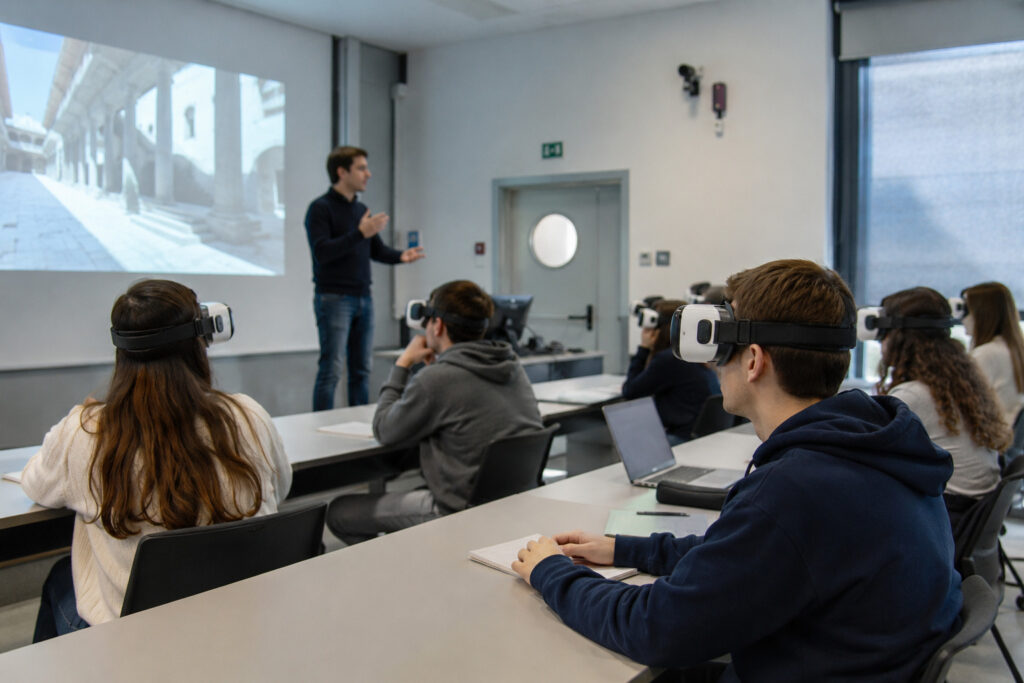
The sectors where virtual reality truly improves training

Universities and higher education
In various faculties, many students encounter difficulty understanding abstract concepts such as formulas, reactions or physical phenomena. VR makes these concepts visible in an immersive way, facilitating more intuitive and engaging understanding.

Technical schools and vocational training
VR allows complex operational procedures to be simulated in complete safety. Students can repeat exercises, make mistakes and correct them in real time, eliminating logistical constraints, risks and costs, making training more effective, scalable and easily repeatable.
Corporate training and onboarding
More and more companies use virtual reality to train new employees, simulate realistic work scenarios and improve both technical skills and soft skills. This approach accelerates learning and increases staff operational readiness.
Guidance and attracting new enrolments
Open days, education fairs and promotional activities become more engaging with VR. It allows students to virtually enter laboratories, professional environments or practical simulations, creating a more effective impact than traditional content.
How we design a virtual reality experience for training and guidance
An effective virtual reality experience for training goes beyond reconstructing a 3D environment: it comes from integrating three fundamental elements: teaching, interaction design and gamification. This approach turns complex content into immersive, measurable and truly effective learning paths.
Teaching and learning objectives
The process always starts with defining learning objectives together with teachers and trainers. Skills to be acquired, key concepts to consolidate and typical errors to overcome are identified. This step is important to ensure VR is not mere entertainment but a structured, measurable teaching tool.
Interaction design
Students are active participants, not spectators. Each experience is designed to enable manipulation, choice, mistakes and repetition. Simulations include interactive variables and immediate feedback systems that guide users through learning in real time.
Gamification and engagement
Elements such as objectives, levels and progression are used to increase engagement and motivation. Gamification does not turn training into a game, but makes the path clearer, more structured and stimulating, supporting greater continuity in learning.
Two modes for students: VR in class and Desktop access from home
One of the main challenges of virtual reality training is hardware availability: not all students have a personal headset. This is why we design experiences with two modes.
The VR version is used in classrooms, laboratories or guidance events, where devices are provided to users. The Desktop version, equivalent in content and learning objectives, is accessible from any computer through a browser with personalised access. This approach allows students to practise independently, revise from home and arrive in class better prepared.
Usage data from both modes is collected in a single dashboard, giving teachers a clear, up-to-date view of the entire class’s progression.
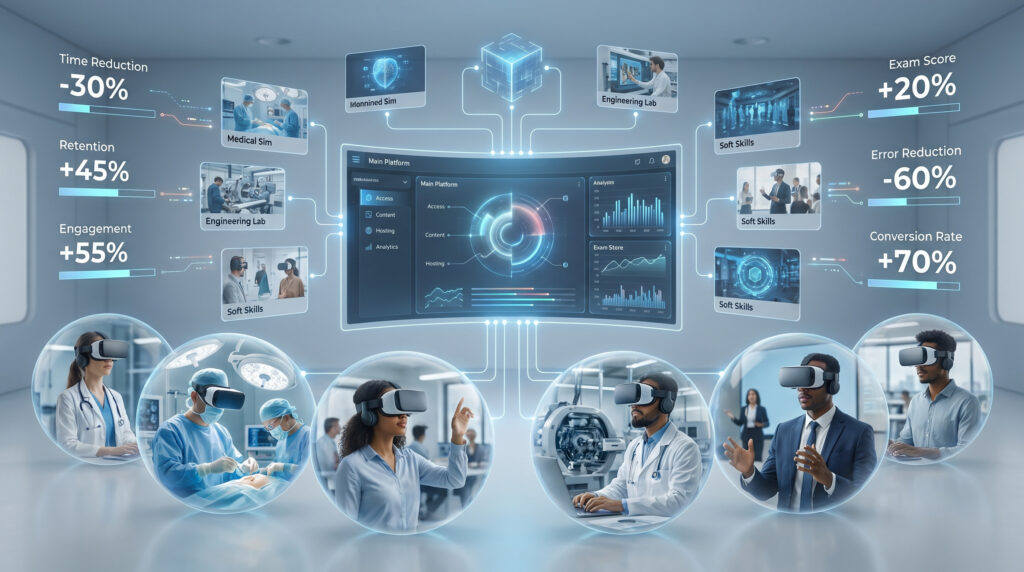
A modular platform for measuring VR training results
Virtual reality training is based on a modular architecture comprising a central platform (access management, content, dashboards and hosting) and independent training experiences, which can be developed and scaled over time.
This approach allows a pilot project to be launched and the system to be gradually expanded with reduced costs and maximum flexibility. Effectiveness is measured through concrete KPIs:
- reduction in learning time
- increase in information retention
- greater user engagement
These are supplemented by specific indicators such as exam performance, reduction in operational errors and conversion rates in training programmes.
Where to start with virtual reality in training: a gradual approach and pilot projects
One of the most common mistakes when adopting VR for training is starting with overly complex and structured projects. The idea of immediately developing a complete platform with multiple modules and integrations often slows or blocks implementation before the operational phase.
The most effective approach is gradual and based on real validation: an essential scope is defined, an initial functional version is developed and one or a few pilot experiences are introduced. This allows system effectiveness to be tested, concrete usage data to be collected and future development to be optimised on a real basis.
Growth then takes place in a scalable way, with subsequent expansions guided by results and training needs. Each project is built in collaboration with teachers, trainers and HR managers to ensure technology always remains a tool serving teaching objectives rather than an end in itself.
Want to find out whether virtual reality can work in your teaching context? Request a consultation
If you are considering an immersive training project, VR solutions for universities and higher education institutions, simulations for companies or high-impact guidance experiences, a brief initial consultation is the quickest way to define opportunities and project scope. In a 30-minute call we analyse objectives, use cases and feasibility, supporting you with concrete examples, real data and an approach based on projects already developed in educational and industrial settings.
Contact us to arrange a consultation: we help you understand whether and how virtual reality can bring real value to your training.
CHOOSE THE RIGHT SOLUTION
Virtual reality for your context.
This page focuses on schools, universities and educational guidance. For staff training or designing challenges and simulations, explore the dedicated solutions.
Frequently asked questions
Find answers to the most frequently asked questions about our virtual reality services for education.
Related projects

OUR CONTACT DETAILS
We look forward to helping you achieve your goals! Would you like a no-obligation quotation? Here are our contact details. Alternatively, complete every field in the form and we will reply as soon as possible!

OFFICE
C.so Unione Sovietica 594,
10135 Torino (TO)

PHONE
+39 378 060 9310