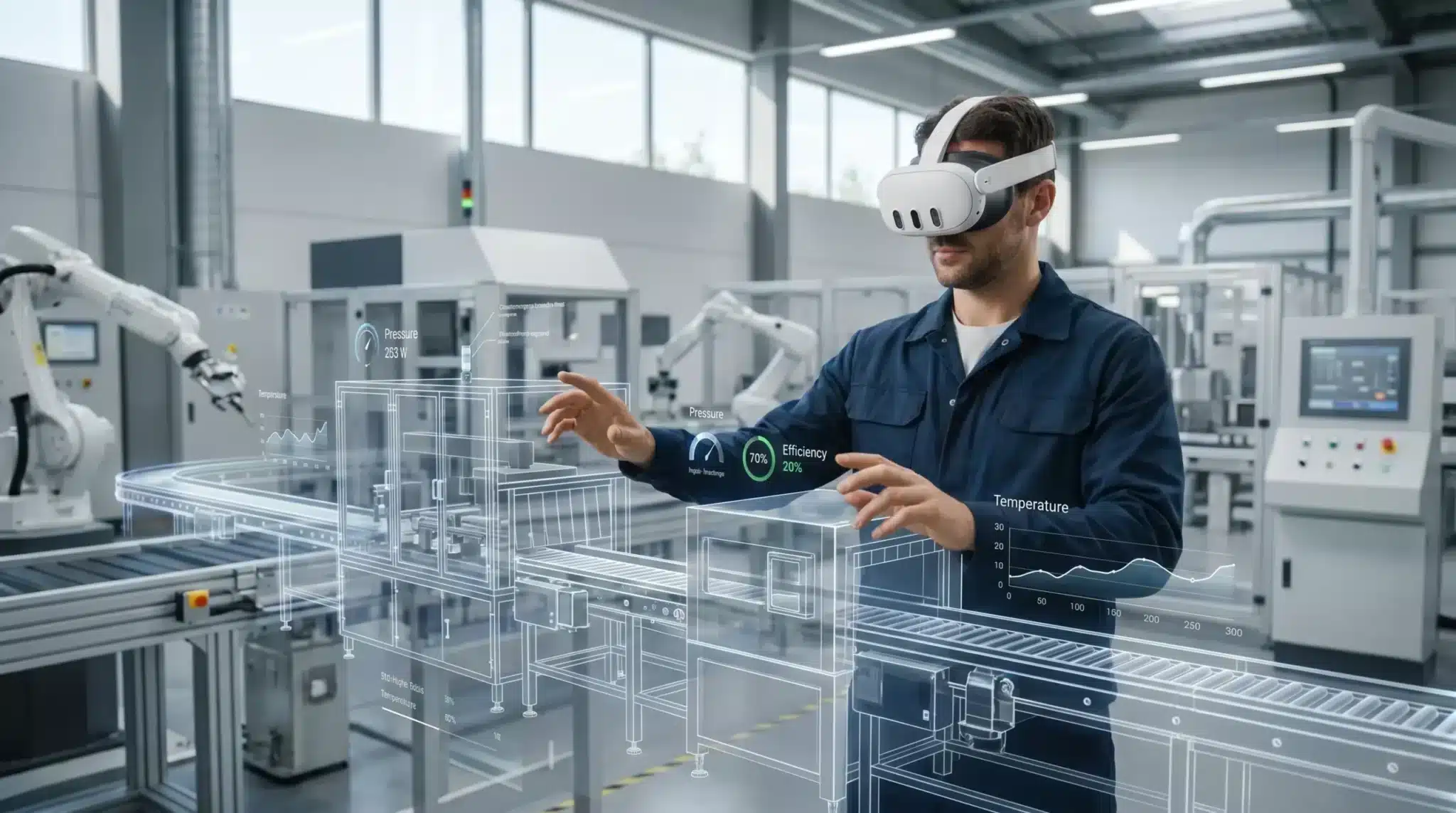
An immersive digital twin connects a 3D replica of a plant, building or process to information from the real system and makes it explorable in virtual reality. It helps users read data in context, test defined scenarios and prepare for operational procedures.
We design the navigable model, interactions and connections to the required data. First, we define what information is available, how often it is updated and which behaviours need to be simulated: a headset alone does not turn a 3D reconstruction into a digital twin.
Explore virtual reality applications.
Understand the system in context
For people managing plants, maintenance, buildings or technical training who need to connect spaces, components, information and procedures.
A 3D tour may be enough
If you only want to show an environment or present a product, a navigable reconstruction may suffice. A digital twin requires a defined connection to the real system.
THE DELIVERABLE
An immersive environment with verifiable information.
We agree on an initial representative asset or process, the actual features and the criteria for accepting delivery.
Navigable 3D replica
Environments and components organised for VR exploration, with the level of detail needed by the selected users and devices.
Contextual data and interactions
Information panels, states, procedures and connections to agreed sources. Continuous updates are included only when sources and integration support them.
Scenarios and testing
Operational journeys or simulations defined within the project, with tests of interactions, data comprehension and experience performance.
THE PROCESS
From the real system to a virtual reality trial.
We separate model quality, information reliability and simulation behaviour: each element requires verification.
Use case definition
We select an asset, users and the decision or procedure to support, with shared verification criteria.
Source analysis
We examine models, drawings, data and update frequency. Availability and permissions are agreed with the relevant contacts.
Environment preparation
We optimise geometry, materials and navigation for the headset, distinguishing useful detail from unnecessary complexity.
Interactions and scenarios
We connect information and procedures to components and develop the defined scenarios, making assumptions and limitations explicit.
Testing with the relevant contacts
We check correspondence with the system, data readability, interactions, comfort and distribution before delivery.
APPLICATIONS
A precise scope for each context.
The same immersive foundation can support different needs. Data, simulations and validation responsibilities must be defined for each project.
Plants and production lines
Exploration of layouts and components, contextual reading of available states and comparison of agreed scenarios. A process simulation requires validated rules and data.
Maintenance and training
Guided journeys to recognise components and follow procedures. Instructions are approved by technical contacts; the experience does not replace qualifications or safety measures.
Buildings, infrastructure and logistics
Navigation of spaces and systems, information consultation and assessment of routes or environment organisation, based on available data.
Connections to sensors, business software or other systems are not automatic. Before promising real-time monitoring, predictive maintenance or physical simulations, sources, access, calculation models and update responsibilities must be verified.
FREQUENTLY ASKED QUESTIONS
Before starting an immersive digital twin.
What is the difference between a 3D model and a digital twin?
A 3D model describes shapes and spaces. A digital twin maintains a defined relationship with the real system through data, states, procedures or simulations. Virtual reality is the immersive way to explore it, not proof that the connection exists.
Is real-time data required?
It depends on the use. Periodically updated data is enough for some activities; operational monitoring requires defined sources, frequency and reliability. Users must be able to distinguish current, historical and simulated information.
Can CAD or BIM models be reused?
Yes, after checking availability, usage rights and quality. Geometry often needs simplifying, components reorganising and materials preparing to keep the experience fluid on the intended headset.
Can it simulate faults or maintenance procedures?
It can include scenarios agreed and validated by technicians. A guided sequence is not equivalent to a predictive physical simulation: behaviour, input data and model limitations must be explicit.
Which headsets and distribution methods are supported?
We choose them according to space, mobility, detail, user numbers and device management. Compatibility, possible offline use and corporate distribution are requirements to agree and test.
What is needed to receive a quote?
A reference asset or process, the objective, users, available models and a description of data sources. Also indicate devices and expected integrations: we define an initial scope without requesting confidential data in the first message.

LET’S TALK ABOUT THE PROJECT
Which system would you like to make explorable?
Tell us about the plant, space or process and what users need to understand or do. We start with a concrete use case and the available materials.
Do not send confidential data in your first message: we agree on access and sharing methods first.
REQUEST A QUOTE
Describe the use case.
Indicate available models, data sources, users and intended devices.