
How much does a 3D e-commerce configurator cost? Budget and integrations
Models, variants, rules and cart: define the scope before requesting a quotation and distinguish a 3D demo from a complete purchasing journey.

The price depends on what must happen after the selection.
A rotatable product and an order ready for production are two different outcomes. The first mainly needs a 3D asset and an interface. The second must connect choices, rules, product codes, price, availability and order data. To compare two quotations, compare the same journey, from the product page to the person receiving the configuration.
In Loto Studios’ published pricing, web/product configurators start indicatively at €2,000; advanced 3D e-commerce solutions start at €8,000. These are references for two different scopes: the first does not automatically mean an integrated store. Missing assets, specific rules and connections to business systems must be specified in the quotation.
The difference between viewing and configuring.
A 3D viewer lets people rotate and inspect a product. A configurator enables consistent choices: materials, colours, components, dimensions or accessories. An e-commerce configurator adds a commercial step: the selection must reach the cart, order or quotation request correctly.
Before adding 3D, identify the uncertainty preventing a choice. If photographs of variants are sufficient, the store’s selector may be enough. If users need to see an assembly of components, understand dimensions or compare finishes from the same viewpoint, 3D can become a useful part of the journey.
The items that actually change the budget.
The product count alone does not describe the work. A family sharing geometry can reuse part of the preparation; very different products need separate assets and checks. The number of combinations must also be considered alongside the rules: not every theoretical combination needs to exist or be purchasable.
| Area | Cost item | To define |
|---|---|---|
| 3D assets | Modelling, cleanup and materials | Available files, expected quality, reusable families |
| Options and rules | Choices, dependencies and incompatibilities | Which combinations are valid and how components change |
| Interface | Selectors, summary and phone use | Purchase journey, accessibility and performance |
| Integration | Codes, cart, prices and availability | Platform, data source and order destination |
| Testing and maintenance | Flow testing and updates | Acceptance criteria, responsibilities and support |
Ask for the quotation to separate asset preparation, interface, rules, integration and acceptance testing. This lets you reduce the first release without removing a necessary dependency, or compare an offer starting from ready models with one including their production.
WooCommerce: the view must reach the correct variation.
WooCommerce manages variable products using attributes and variations. A variation can have its own price and availability. In the Store API, adding an item to the cart uses the product or variation and the associated attributes. The configurator therefore needs to translate visual choices into the actual purchasable product, rather than only changing its colour on screen. Variable products · Cart Items API.
For example, an armchair may offer fabric, colour and base choices. If some bases are incompatible with a fabric, the selector must reflect that rule. When the combination is added to the cart, its summary, code and price must describe the same choice. The order must retain the information needed to prepare the product. This is an example of a flow to design, rather than a claimed client result.
Shopify: distinguish variants from personalisation.
Shopify’s Cart API adds variants identified by their ID to the cart and supports additional line item properties. These properties can describe personalisation; their presence alone does not constitute a pricing system for every combination. Define how purchasable choices are represented and how the information reaches the order. Cart API documentation.
A modular piece of furniture therefore requires an initial decision: do customers buy combinations already assigned a code, or submit a composition for quotation? In the latter case, the useful result may be a summary of modules, finishes and dimensions followed by a commercial enquiry. Forcing every composition into a standard variant selector can shift complexity and cost into catalogue management.
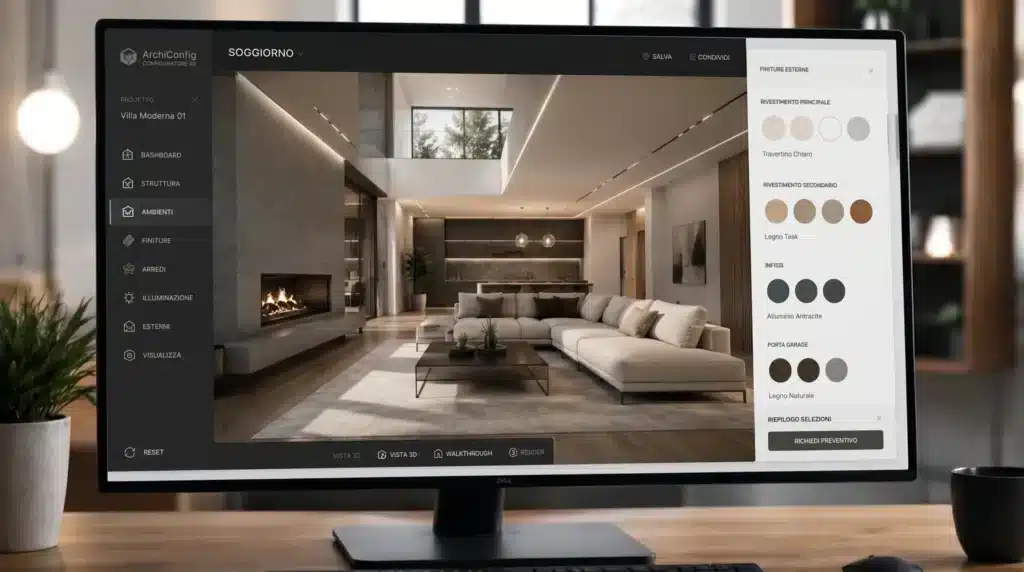
The 3D model is an operational asset, not just an image.
A complete CAD file can speed up the work, but it needs checking for the final channel. Invisible internal parts, overly dense surfaces and large textures can make loading heavier. Configurable parts must be identifiable in the model: a single object is insufficient if users need to change a handle, base or panel.
In the estimate we separate geometry, materials and variants. A colour can share geometry; a dimension may need a different asset or a transformation rule. Finishes need comparison with approved references and checks on real phones: reflections and detail should support a choice even on a small screen. For the full service, see the 3D e-commerce configurator.
Dynamic pricing, stock and data: decide who updates them.
The quotation must identify where prices, availability and rules come from, and who maintains them. Manual updates across two systems create recurring work; an automatic connection instead requires a precise definition of the data, updates and errors to handle. Even a small project needs someone responsible for this information.
Before release, check at least a price change, an out-of-stock variant, an incompatible combination, a different quantity and resuming a saved configuration where supported. For each test, compare the on-screen choice with the cart summary and what the team receives. A useful test covers the complete journey, rather than only the smoothness of the model.
Maintenance and total cost after launch.
The initial cost does not cover the whole project. Clarify what happens when a product changes, a new finish arrives, the store is updated or a price list changes. Distinguish work on the model, data updates, integration compatibility and support. Hosting and external services, where required, must be stated separately.
For a first release, choose one product family and a complete commercial journey. Agree what your team needs to update and which changes require development. A demo with many options but unreliable data can be less useful than a limited assortment correctly connected to the store.
What this means for your business.
A reliable budget starts with a project brief: product family and count, available assets, options and incompatibilities, platform, price source, destination of the selection and update management. Add a simple configuration, a complex one and an impossible one: they make the scope concrete before building the demo.
Loto Studios assesses 3D production, interaction and integration together. The initial discussion separates what is already available from what needs building and defines a first version that can be tested. After launch, measure configuration starts and completions, transitions to the cart or enquiry, errors and the quality of information received. Compare these data with the previous journey: value needs to be observed in the commercial process.
Questions about the cost of an e-commerce configurator.
Does the price include 3D models?
It depends on the available files and agreed scope. Ask for modelling, cleanup, materials and variants to be stated separately from store integration.
Is a €2,000 web configurator a complete e-commerce solution?
This is the published starting reference for web/product configurators. Connecting cart, order, prices and availability defines additional scope; published advanced e-commerce solutions start at €8,000.
Can the project start from CAD?
Yes, after checking geometry, scale and configurable parts. Web use may require simplification, materials and textures suited to the channel.
Can I change a price list without rebuilding the 3D?
This is a requirement to define in the project. If commercial data and assets are separated, price list updates can follow a different flow from model production.
How do I compare two quotations?
Compare included assets, rules, connections, order data, acceptance tests and maintenance. The number of options alone does not describe complexity.
What should I send for an initial estimate?
A catalogue, available CAD or 3D files, option list, incompatibilities, store platform and an example of what needs to reach the order or enquiry.
Sources and update
Technical verification: 12 October 2026. Prices shown are those already published by Loto Studios; the budget explanations and examples are design criteria rather than platform price lists.
Shopify Cart API · WooCommerce Cart Items API · WooCommerce variable products · Loto pricing and scope
KEEP EXPLORING
From the choice to a working configurator.
3D configurators
An overview of journeys, rules and integrations.

3D e-commerce
Product choices connected to the commercial journey.

Product configurator
Product materials, components and variants.


