
META CONNECT 2026 · VIRTUAL REALITY
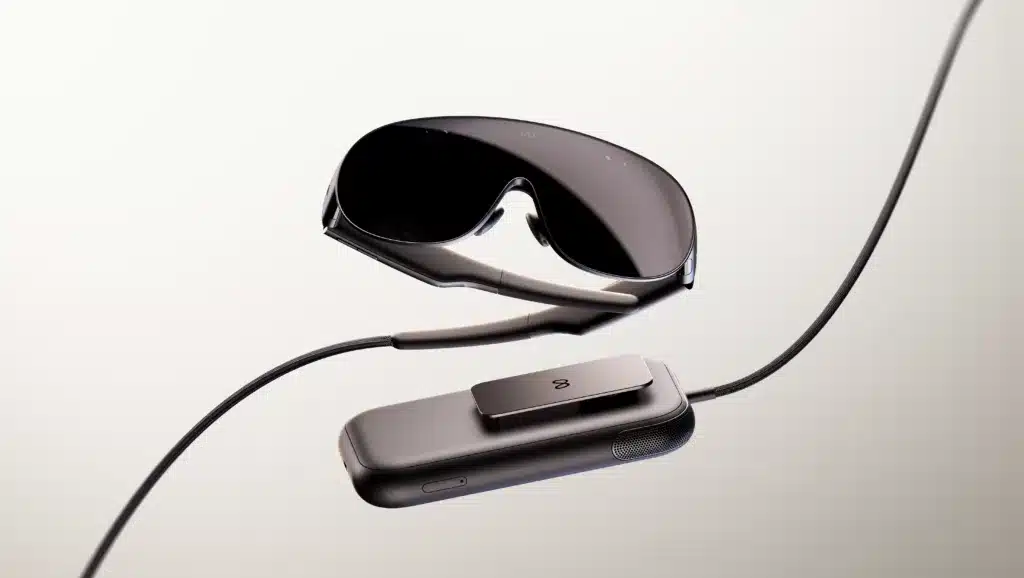
A 100-gram VR device, with the computer in your pocket.
On September 23, 2026 Meta unveiled Meta VR Glasses: a glasses-like VR device with a 5K micro-OLED display and an external compute puck that moves processing, battery and storage away from your face. They are scheduled for spring 2027 at $1,299.99. The most interesting change is not a single spec: it is Meta’s attempt to make high-end VR light enough to wear for hours.
≈ 100 g
weight on the face
5K micro-OLED
37 pixels per degree
$1,299.99
announced US price
Spring 2027
launch window
AT A GLANCE
Meta VR Glasses: key specifications
Meta calls this its most advanced VR device yet. Unlike a conventional headset, the part you wear mainly houses displays and sensors, while a separate module connected by an optical tether handles compute, battery and storage. It is a deliberate trade-off: less weight on your face in exchange for a second component in your pocket or bag.
| Form factor | VR glasses + external compute puck |
| Weight | About 100 g on the face |
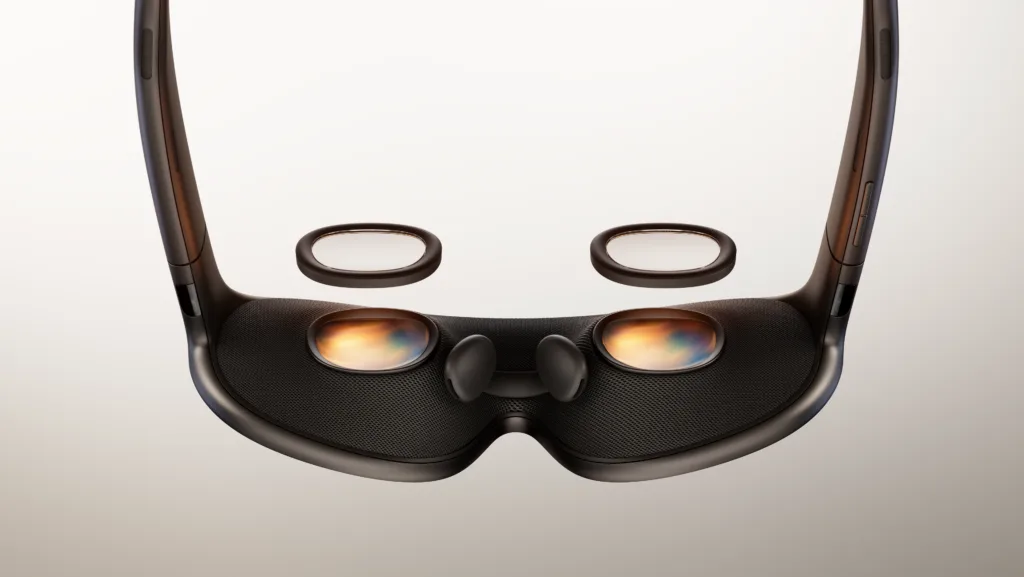
| Display | 5K Infinite Display, micro-OLED, 37 PPD |
| Optics | Ultra-compact pancake lenses |
| Processor | Qualcomm Snapdragon Reality Elite |
| Input | Eyes, hands and voice; Touch Plus compatible |
| Audio | Dolby Atmos integrated into the frames |
| Claimed battery life | Up to 3 hours of high-resolution media playback; 45 W charging |
| Price / release | $1,299.99 · spring 2027 |
THE REAL SHIFT
The innovation is moving weight off your head
Quest 3 and most standalone headsets keep nearly all their hardware on your head. Meta VR Glasses split the system in two: displays and sensors stay on the face, while the puck does the heavier work. Meta says the glasses are about five times lighter than Quest 3.
For teams designing immersive experiences, that may matter more than another raw performance jump. Comfort, session length and physical fatigue are still real constraints in professional VR.
Meta VR Glasses vs Meta Quest 3: different products, different priorities
Calling Meta VR Glasses a “mini Quest 4” would miss the point. Quest 3 is a mainstream standalone headset focused on gaming and mixed reality. Meta VR Glasses push much harder toward wearability, cinema, spatial computing and multi-screen work, while still keeping access to the Quest catalogue.
| Feature | Meta VR Glasses | Meta Quest 3 |
|---|---|---|
| Architecture | Glasses + puck | Standalone all-in-one |
| Weight on face | ≈ 100 g | Meta says about 5× heavier |
| Display | 5K micro-OLED | 4K+ LCD |
| Interaction | Eyes, hands, voice; controllers optional | Touch Plus + hand tracking |
| Primary focus | Cinema, workspace, spatial computing, premium gaming | Gaming, fitness, entertainment, mixed reality |
| US price | $1,299.99 at launch | $599.99 for 512 GB on Meta Store |
| Availability | Spring 2027 | Available now |
OFFICIAL VIDEO
Meta VR Glasses at Meta Connect 2026
BEYOND GAMING
Workspace, AI and controller-free interaction
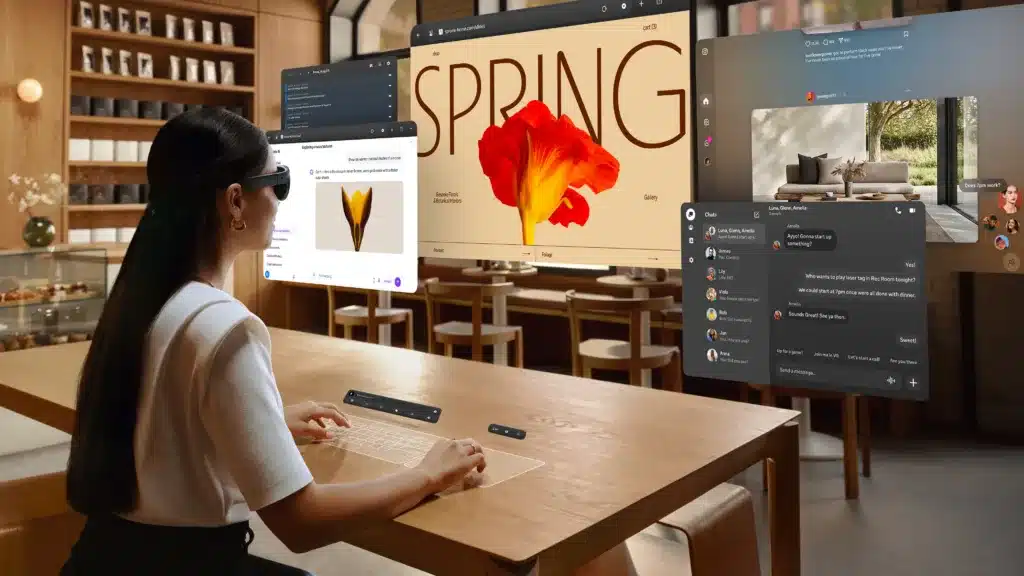
Meta integrates its AI agent directly into the operating system and positions eye tracking, hand gestures and voice as primary input methods. The device can create one or more private virtual displays and connect to Mac or Windows wirelessly or over USB-C.
For gaming, Meta says more than 75 titles will support hand tracking only at launch, alongside the wider Quest catalogue and compatibility with Touch Plus controllers.
FOR BUSINESS
Why this form factor could matter for professional VR
The business value will not come from the spec sheet alone. It will depend on whether the new format can reduce three persistent frictions: comfort in longer sessions, onboarding time and the naturalness of interaction.
Training and simulation
Lower facial weight could make repeated training and simulation sessions easier to sustain. Tracking quality in real operating environments will be one of the key things to validate.
Design and digital twins
Sharper text, multiple virtual screens and PC connectivity are promising for product reviews, 3D visualization, prototyping and digital twin workflows.
Events and brand experiences
A faster, lighter fit could reduce friction at events. Hygiene, puck management, battery life and hardware durability will still matter in public installations.
What we would test before recommending it for a real project
- comfort after 30, 60 and 90 minutes;
- hand and eye tracking accuracy under different lighting conditions;
- passthrough quality for text, tools and nearby objects;
- latency and stability when connected to a PC;
- device management, updates and application deployment;
- real battery life under interactive 3D workloads, not just video playback;
- puck and cable ergonomics during movement, training and events.
Until those questions are answered, it would be premature to call Meta VR Glasses a universal Quest 3 replacement. On paper, however, the design tackles the right problem: making VR feel less like wearing a helmet and more like using a device you can actually keep on.
From hardware to immersive experience
Better hardware does not automatically make a better application. UX, performance, interactions, 3D content and device testing still determine the result. Loto Studios designs and develops virtual reality applications for companies, from training and simulation to immersive experiences.
Meta VR Glasses FAQ
When will Meta VR Glasses be released?
Meta says they will go on sale in spring 2027. As of September 24, 2026, no more specific date has been announced.
How much will Meta VR Glasses cost?
The announced US price is $1,299.99. Local pricing and availability may differ and should be checked closer to launch.
Do they replace Meta Quest 3?
Not directly. Meta VR Glasses target a much lighter form factor, micro-OLED displays and premium spatial computing. Quest 3 remains a more affordable standalone headset for the mainstream market.
Do Meta VR Glasses need controllers?
Not for core interaction. Meta positions voice, eye tracking and natural hand gestures as primary controls. Touch Plus controllers remain compatible where needed.
Can they connect to a PC?
Yes. Meta says the device can connect to Mac and Windows wirelessly or via USB-C, while still supporting a physical keyboard and mouse.
Are they already a good choice for enterprise VR?
It is too early to say. The specifications are promising, but professional deployments need real-world validation of comfort, battery life under load, tracking, device management, software stability and availability.
Sources and update policy
Last updated September 24, 2026, based on the official Meta announcement and Meta Newsroom. Specifications and commercial terms may change before the 2027 launch. Product images and video: Meta.


